We are a Community Interest Company rooted in the principle of real equality. As a CIC, every penny we earn is reinvested into the people and communities we serve, and every contract we deliver generates measurable social value. That means doing the work that doesn't fit into boxes, sitting with people in the messy middle, advocating when nobody else will, and refusing the comfort of easy answers.
Across 25 years of frontline practice, we've supported people and families experiencing intersectional disadvantage, where substance misuse, eating disorders, abuse, homelessness, unemployment, neurodivergence and the difficult transition out of the care system rarely arrive one at a time. We work with the whole picture, not a single label.
We also work with the people who do this work, training social workers, school staff, NHS teams and local authorities in trauma-informed practice and contextual safeguarding, the recognition that young people's safety is shaped as much by their peer groups, schools and online lives as by what happens at home. And we work with businesses, helping founders find the courage and clarity to grow.
Our founder, Joanne King, is a qualified and experienced behaviour change, relationships and social impact specialist who believes that healthy relationships are everything. The relationship we have with ourselves shapes how we connect with others, how we work together and how we respond to difficulty. Joanne has successfully led complex, multi-sectoral and multi-disciplinary partnerships across several local authority areas and within some of the most challenging sectors, bringing organisations and professionals together around shared outcomes for people, families and communities.
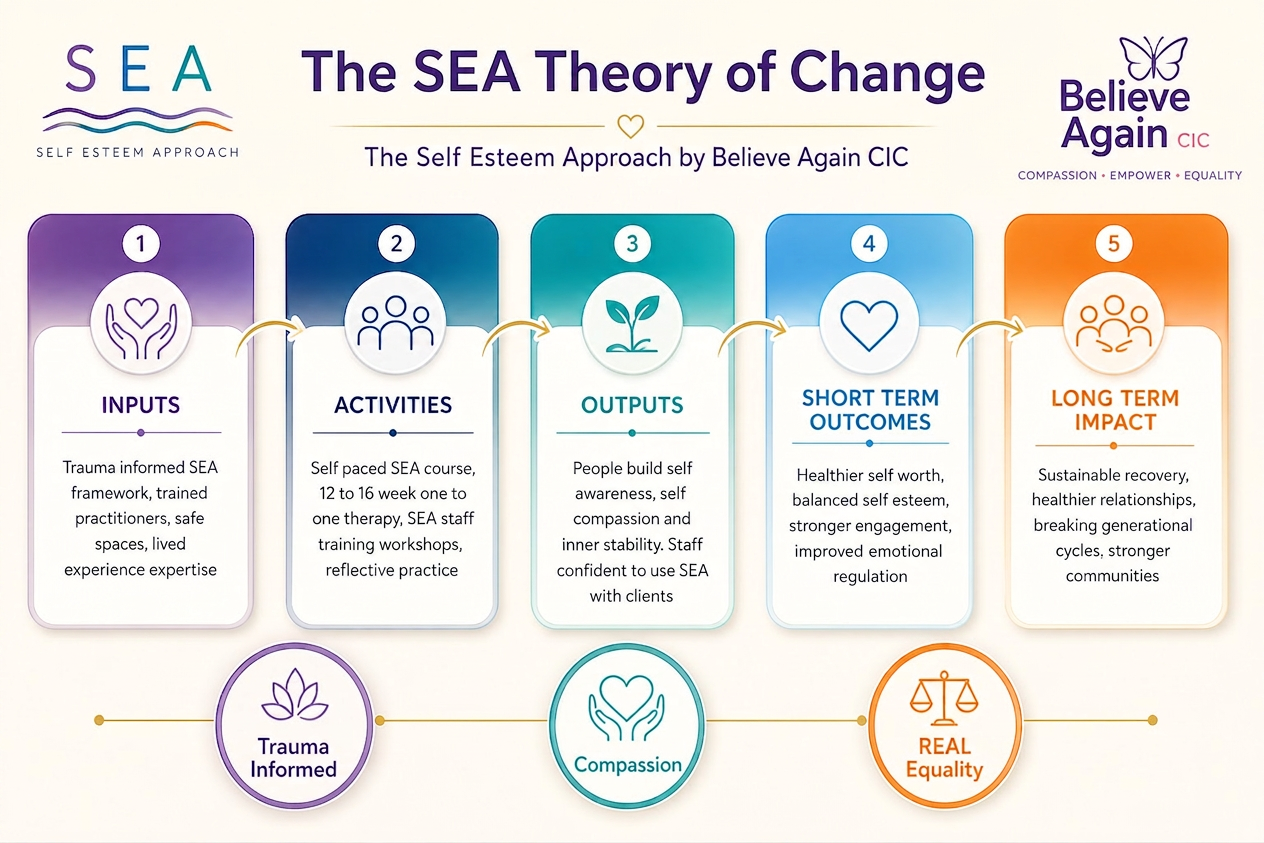
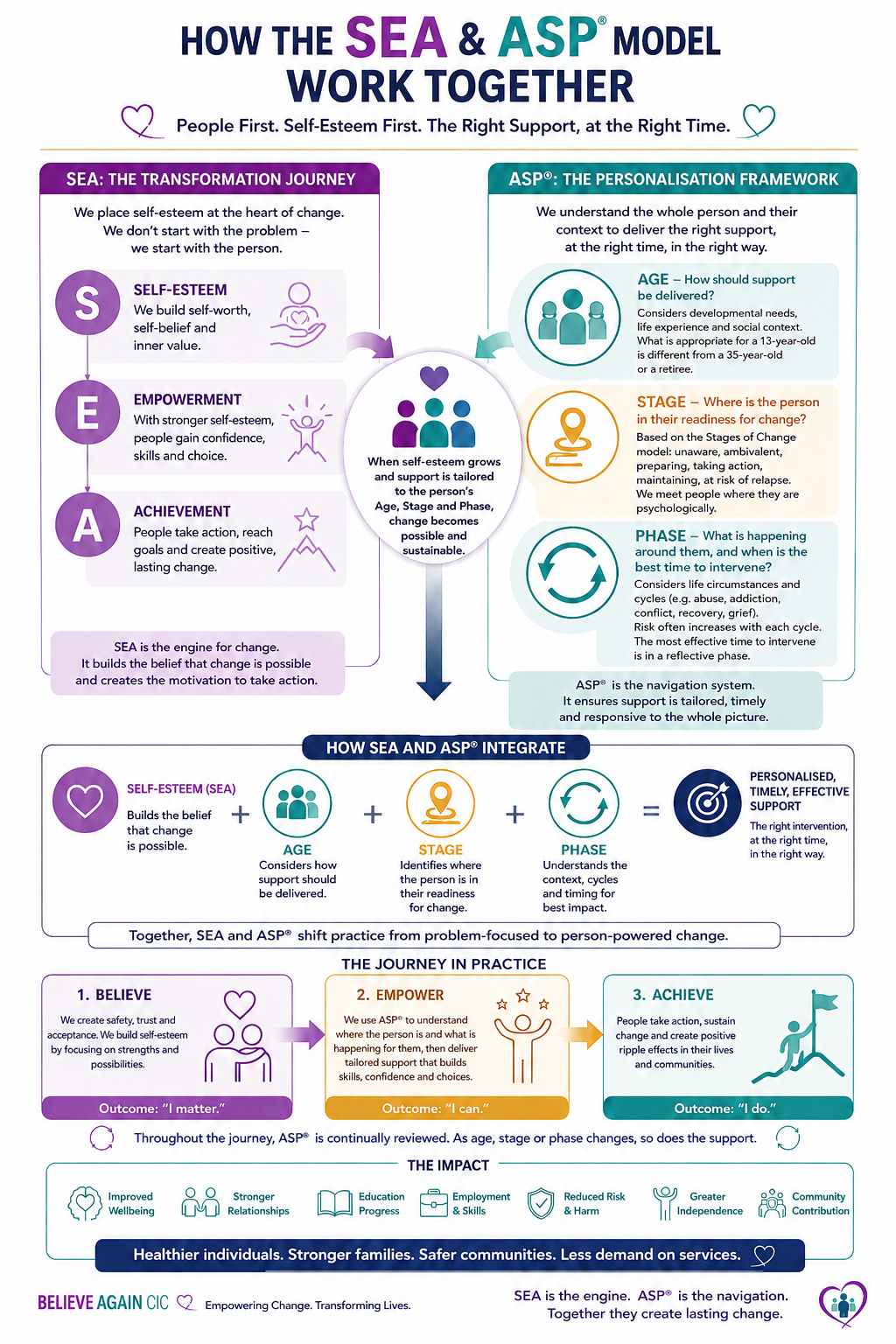
At the heart of our work is The Self-Esteem Approach™ (SEA™), developed by our founder Joanne King. Drawn from 25 years of lived and professional experience, SEA™ places a truthful, compassionate relationship with the self at the centre of lasting change. It is the framework that underpins every service, training programme and consultancy conversation we offer, because without focusing on self-esteem, other interventions are less effective.
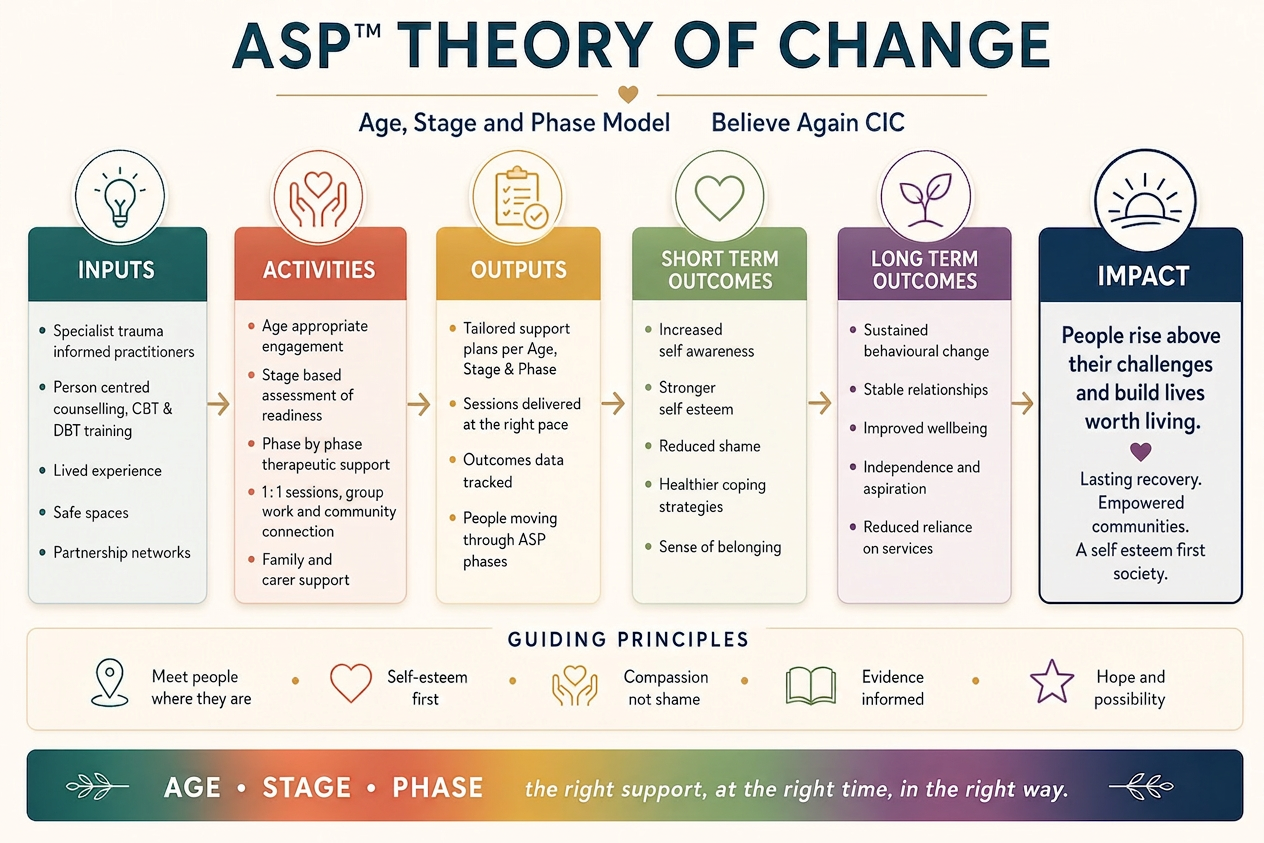
Joanne also created an early intervention and prevention model, Age, Stage and Phase rooted in a simple belief: prevention is better than cure. Wherever possible, we aim to intervene early and stop harm before it takes hold. And where prevention is no longer possible, our services are built to meet people at every age, stage and phase of their recovery journey, no one is ever too far along to be supported.
ASP wasn't something I sat down and decided to invent. It came from practice.
In 2022, while working in domestic abuse, I was preparing to speak at a conference about six prevention and early-intervention projects I was managing. I had ten minutes. There was absolutely no way I could meaningfully explain six separate projects in that time, so I started looking at what connected them.
And that's when I saw it: Age. Stage. Phase.
Who are we trying to reach, and at what age can we intervene or prevent harm? What stage of change are they at? And what phase of their circumstances are they in when intervention is most likely to make a difference?
What began as a simple way of explaining complex work became a framework for thinking about when, where and how we intervene.
The original ASP model was developed by me while working at MyCWA and was specific to domestic abuse. I have since developed and expanded the concept through Believe Again CIC so that its principles can be applied much more widely across early intervention, prevention and behaviour change.
Sometimes innovation isn't about creating something more complicated. It's about suddenly seeing the pattern that was already there.
If 25 years of practice has taught us one thing, it is this: self-esteem comes first. Self-esteem is not always about lifting someone up, sometimes it is about honesty, accountability and a realistic perspective. When people learn to value themselves truthfully, change is not only possible, it also becomes sustainable, the kind that holds long after the support ends.
Where Believe began.
Believe began life in 2013 as Be-lieve CIC, set up specifically to deliver the LIFT project. The name was an acronym for Building Esteem and Love in EVEryone, a founding principle that still runs through everything we do today.
LIFT (Let's Improve our Futures Together) originally started in 2011, delivered by Home Start Central Cheshire. Be-lieve CIC took over delivery of the contract in 2013 and completed the project in 2015, a £900,000 Lottery funded programme improving outcomes for families with multiple and complex needs across four local authority areas.
More than a decade on, the organisation has grown into Believe Again CIC, but the original commitment has not changed: build esteem, and love, in everyone.
In every person's capacity for change, dignity and growth.
By identifying strengths, not just diagnosing problems.
By doing the work systems often refuse to do.
Our approach.
Our model is shaped by 25 years of frontline practice and the simple belief that prevention is better than cure. We meet people earlier, stay longer, and work with the whole picture, not a single label.
- 01Listen first, label last
We start with the person, not the paperwork. Lived experience leads the conversation, and assessment follows trust, not the other way round.
- 02Self-esteem at the centre
Sustainable change rests on a truthful relationship with the self. Every service we offer, from 1:1 to training, is built around our Self Esteem Approach™ (SEA™).
- 03Early intervention and prevention
Wherever possible we step in before harm hardens. Where prevention is no longer the option, we meet people at every age, stage and phase of recovery.
- 04Trauma-informed and contextually aware
We work with the whole context: family, peer group, school, workplace, online life. Safeguarding is contextual, not just generic.
- 05Strengths, not just symptoms
We name what is working as carefully as what is not. Empowerment comes from people recognising their own capacity, supported by honest accountability.
- 06Reinvested social value
As a CIC, every contract is measured in social value as well as outcomes. Profits stay in the community we serve.
SEA™ is the framework at the heart of everything we do, from 1:1 support to workforce training. Built from 25 years of lived and professional experience, it puts a truthful relationship with the self at the centre of lasting change.
Learn more about SEA™How it all fits together.
Two complementary models sit at the core of our practice, SEA™ (the engine for change) and ASP™ (the navigation system). Together they create personalised, timely and effective support.
What people say.
A small selection of feedback from the people, families and organisations we've walked alongside.
Joanne saw me as a whole person. For the first time in years I felt genuinely heard, and that's where everything started to shift.
The training landed in a way other sessions haven't. Our team left with practical tools, not just theory, and our practice has been better for it.
Honest, kind and refreshingly free of jargon. The Business Fairy helped me rebuild the confidence to actually run my business, not just survive it.
Want to talk it through?
Reach out, we respond to every message personally.